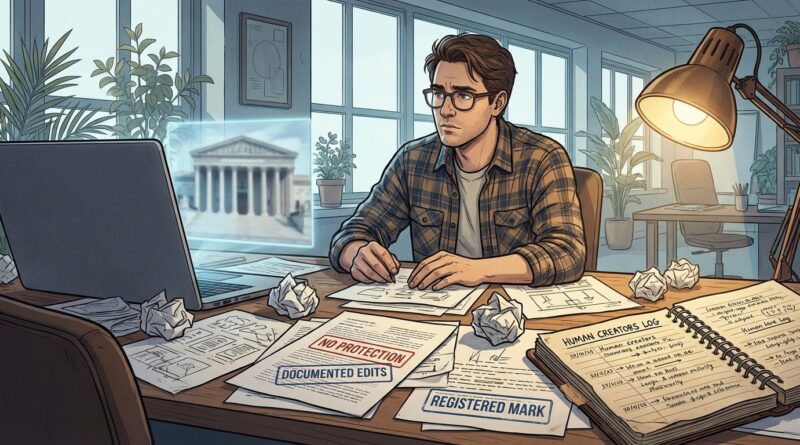
New Supreme Court AI Copyright Ruling: Why Your Brand’s Prompts, Logos And Product Photos May Be Barely Protected
You can see why small business owners are annoyed right now. You paid for the AI tool. You wrote the prompt. You clicked generate 40 times until the logo, product photo, or mascot finally looked right. So of course it feels like you should own it. The problem is that the latest Supreme Court ruling, and the legal thinking around it, keeps pushing the same idea. Copyright protects human authorship, not work made entirely by a machine. That means a lot of AI-first branding may be much weaker than people think. If your process was basically “type prompt, download file, post online,” you may have a hard time stopping a copycat from reusing something very close to your visual style. The good news is this is not a reason to panic or stop using AI. It is a reason to change your workflow so your human decisions are obvious, traceable, and worth protecting.
⚡ In a Hurry? Key Takeaways
- Purely AI-generated logos, product photos, and brand art may get little or no copyright protection because copyright still centers on human authorship.
- If you use AI, keep drafts, edits, sketches, prompt history, and proof of your creative choices so you can show what a human actually made.
- Copyright is only one layer. You may still protect parts of your brand through trademarks, contracts, licensing terms, and consistent brand documentation.
What the ruling means in plain English
The short version is simple. Courts are sticking with a rule that has been building for a while. Copyright is for human-created expression. Not just human effort. Not just human ownership of the tool. Human authorship.
So if a machine creates the expressive part of the work on its own, that work may not qualify for copyright protection. This is the big wake-up call for brands using AI to crank out visuals fast.
If your designer or founder gave an AI tool a loose prompt like “minimalist coffee brand logo, warm brown palette, retro feel,” and then downloaded the winner, that final image may sit in a gray area. You used the tool. But did you create enough of the protectable expression as a human? That is the question.
Why this matters to brands more than to casual users
If you are making funny images for your group chat, this is mostly a shrug. If you are building a company look and feel, it is a much bigger deal.
Brand assets are supposed to do two jobs. First, they help people recognize you. Second, they help you stop others from copying you. If your AI-made logo, hero image, mascot, packaging art, or social graphics are weak on copyright, the second job gets shaky fast.
That means a rival could copy the vibe, remake something very close, or reuse AI-generated material that looks a lot like yours, and your legal options might be thinner than you expected.
The key phrase to understand: human authorship
When lawyers talk about AI copyright Supreme Court human authorship brand protection, they are really asking one practical question. Where did the human creativity show up in a clear, provable way?
Human authorship usually looks like this
A person sketches the logo shape first, then uses AI to test textures. A photographer shoots the original product photo, then uses AI only to extend the background. A creative director builds the mascot’s backstory, pose sheet, color system, and facial traits, then uses AI for variations that are later hand-edited.
In those cases, the human is not just pushing a button. The human is making original expressive choices before, during, and after the AI step.
Human authorship usually does not look like this
Typing a prompt, picking one of four outputs, and exporting the file. That may involve taste. It may involve effort. But taste and effort alone are not always enough for copyright.
What kinds of brand assets are most exposed?
Logos
AI logos are risky because logos are often simple to begin with. If the AI generated the core design and you did not significantly redraw or refine it yourself, copyright may be weak. You may still have trademark options if you actually use the logo in commerce, but that is a different kind of protection.
Product photos
Fake product shots made fully inside an AI image tool are vulnerable. If there was no real photography and little human editing beyond prompt changes, those images may be hard to protect. That matters if competitors start posting very similar “lifestyle” shots.
Brand mascots and characters
This one surprises people. If your mascot came out of an AI generator mostly fully formed, your rights may be thinner than if you had developed the character with sketches, notes, style sheets, and revisions made by a human artist.
Social media graphics
The more disposable the content, the less people think about ownership. But if you are building a repeating visual language across campaigns, you should care. Recycled AI art can spread fast, and enforcing exclusivity may be harder than expected.
Copyright is not the same thing as trademark
This is where many brand owners get mixed up. Copyright protects original creative expression. Trademark protects source identification, meaning the name, logo, slogan, or visual sign that tells customers “this comes from us.”
So even if a logo has weak copyright because it was mostly machine-generated, it might still gain trademark strength if you use it consistently in the market and customers connect it to your business.
But do not treat trademark as a magic backup plan. Trademark rights take use, consistency, and sometimes registration. They also do not protect every image in your content library. Your AI-generated product photos and campaign art still need their own strategy.
How to make AI-assisted brand work safer
You do not need to throw out AI. You need to stop treating it like a vending machine that spits out fully ownable assets.
1. Start with human-made source material
The safest workflow is to begin with something clearly made by a person. That could be a hand sketch, mood board, wireframe, original photo shoot, written character brief, or a layout created in a design app.
Then use AI to explore options, not to create the entire thing from thin air.
2. Edit the result in a real design process
If you generate a logo concept with AI, redraw it in Illustrator or another design tool. Change the geometry. Adjust spacing. Rebuild the typography. Make original choices that are yours.
If you create a product image with AI, combine it with real photography, custom retouching, hand-built compositions, and manual color work.
The point is not to “touch it up” for five seconds. The point is to create a record of human creative contribution.
3. Keep your drafts and receipts
This part is boring. It is also the part that can save you later.
Save your sketches, design boards, revision files, prompt history, exported versions, notes from creative reviews, and screenshots that show how the work changed over time. If a dispute comes up, you want a timeline that proves your human role.
4. Use written contracts with freelancers and agencies
If someone helps build AI-assisted brand assets for you, your contract should say what tools they used, what parts are human-created, what rights are being assigned, and whether any outside source material was fed into the system.
If you skip this, you may end up with a mess where nobody is sure what you actually own.
5. Register what you can, honestly
If a piece contains enough human authorship, you may be able to register the human-created parts. Be truthful about the AI role. Trying to hide machine-generated content is a bad idea and can create bigger problems later.
6. Build trademark protection for core brand assets
Your business name, core logo, tagline, and maybe even a distinctive mascot design should be reviewed for trademark use and registration strategy. For many small brands, this is the practical shield that matters most.
A smart workflow for logos, photos, and mascots
For logos
Use AI for brainstorming only. Pick ideas, not final files. Then have a human designer redraw the chosen direction from scratch, document the revisions, and test it across packaging, web, and signage.
For product photos
Shoot your real product first. Then use AI for background concepts, lighting tests, or scene expansion. Keep the original files and layered edits so the human-created core is easy to show.
For mascots
Write a character brief. Define age, personality, colors, expressions, props, and poses. Create a pose sheet or turnarounds with a human illustrator. If AI is used, use it to explore ideas, then finalize the character manually.
What copycats may do now
The danger is not always that someone steals your exact file. It is often that they make something close enough to confuse customers or weaken your visual identity.
That is why relying only on a downloaded AI image is risky. If your “ownership” is thin, a competitor can often say they generated something similar on their own or lightly remixed public-looking AI output. Then you are stuck arguing over facts that are hard to prove.
Questions every brand should ask before publishing AI visuals
- Did a human create the core expression, or just type prompts?
- Can we show our creative process with files and revisions?
- Are we using this as a one-off image, or as a long-term brand asset?
- Should this be rebuilt by a human designer before launch?
- Do we need trademark protection in addition to copyright?
- Do our contracts clearly assign rights and explain AI use?
The practical rule: treat AI output like a rough draft, not a deed
That is the mindset shift. Downloading an AI image is not the same as locking up ownership. Think of it like receiving a first draft from a very fast but legally messy assistant.
You still need to shape it, document it, and turn it into something that clearly carries human authorship.
At a Glance: Comparison
| Feature/Aspect | Details | Verdict |
|---|---|---|
| Pure AI-generated logo | Prompted and downloaded with little or no human redrawing or design work | Weak copyright. Consider human redesign and trademark use. |
| AI-assisted product photo | Real photo or human-made layout used as the base, then edited or expanded with AI | Stronger position if human choices are clear and documented. |
| Brand mascot built with briefs and revisions | Human-created character notes, sketches, model sheets, and manual final artwork | Best path for protection. Keep records and explore trademark too. |
Conclusion
The main lesson is not “stop using AI.” It is “stop assuming the download button equals ownership.” This helps the community right now because many small brands are rushing out AI-generated branding without realizing that saving only the final image is no longer enough when courts keep centering human authorship. If you build clear human decisions into each logo, product shot, and ad concept, and keep proof of that process, you put yourself in a much better position. You keep more control over your brand, make life harder for copycats, and avoid finding out too late that your most important visuals were standing on legal thin ice.