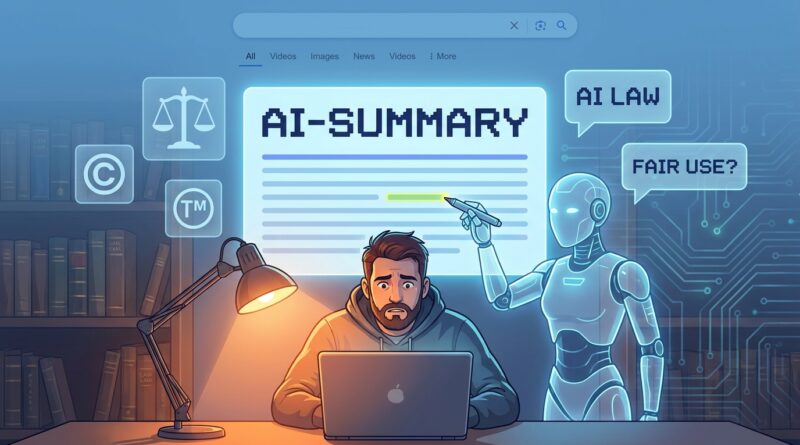
New Court Ruling On Google’s AI Overviews: Does An AI Summary Count As Trademark Use?
You work hard to build a brand name, then Google shows an AI summary that mixes your name into a quick answer you did not write, approve, or even see coming. That is frustrating. It can also feel a little creepy. The big legal question is simple to ask and surprisingly hard to answer. If Google’s AI Overview mentions your brand, is that actually trademark use? A German court has now said, in one important case, not in the traditional sense. That may sound like lawyer talk, but it matters a lot for founders, shop owners, app makers, and anyone who depends on search traffic. If a brand mention in an AI-generated summary does not count as trademark use, some classic infringement claims get harder to make. The good news is you are not powerless. It just means your playbook has to change. Think less “automatic trademark complaint,” and more “proof, monitoring, and smart brand strategy.”
⚡ In a Hurry? Key Takeaways
- A German court found that a brand mention inside a Google AI summary was not traditional trademark use, which may weaken standard infringement claims in similar cases.
- Start tracking how AI Overviews describe your business, save screenshots, and collect real examples of customer confusion if you think your brand is being misrepresented.
- This does not mean your trademark is worthless. It means reputation, distinctiveness, unfair competition claims, and evidence of confusion may matter more than ever.
What happened in plain English
A German court looked at a dispute involving Google’s AI-generated search summaries, often called AI Overviews. The issue was whether mentioning a brand name inside one of those summaries counted as “use as a trademark.”
The court’s answer was basically no, at least under traditional trademark rules in that case. In simple terms, the court treated the AI summary more like informational text than a sign used to identify the source of goods or services.
That distinction sounds tiny. It is not. Trademark law often turns on whether a name is being used to point people to a specific commercial source, or whether it is just being referenced in a piece of text.
Why this matters to small brands
If you run a small business, you probably think about trademarks in a very practical way. If somebody uses your name online in a misleading way, you want a fast path to make it stop.
This ruling suggests that path may be narrower when the use happens inside an AI-generated answer box. If the court sees the text as a descriptive or informational mention, instead of trademark use, then a classic infringement claim may not fit as neatly as you hoped.
That does not mean Google, or any AI tool, gets a free pass forever. It means the legal label matters. And right now, courts are still figuring out what these AI summaries really are.
What “trademark use” actually means
Here is the coffee-shop version.
Trademark law is not triggered every single time your brand name appears on a screen. Usually, the use has to do trademark work. It has to act like a badge of origin. In other words, it tells people, “this product or service comes from this company.”
If your brand is simply mentioned in a sentence, compared with others, or pulled into a machine-written summary, a court may say that is not the same thing.
A simple example
If someone sells shoes under your brand name, that is classic trademark use.
If someone writes, “Brand X is known for comfortable shoes,” that may just be a reference.
AI Overviews land in the messy middle. They can look authoritative, they can influence clicks, and they can shape buyer perception. But a court may still say they are summaries, not source labels.
Why founders should not panic, but should pay attention
The scary part is obvious. Your brand can be summarized, paraphrased, or blended into generic wording by an AI system, and you may not be able to rely on your usual trademark argument.
But there is another side to this.
This ruling does not erase other legal options. It just means you may need better facts and a broader strategy. If an AI Overview creates confusion, harms your reputation, or repeats false claims, the legal angle might shift toward unfair competition, false statements, or other brand protection tools depending on the country.
What the court ruling changes in practice
1. Standard infringement claims may be harder
If the disputed brand mention is inside an AI-generated summary, a court may ask whether the name is really being used as a mark, or merely mentioned in text.
That can make takedown demands less straightforward.
2. Evidence becomes more important
You may need to show real confusion, real harm, or clear reputational impact. Not just annoyance.
That means screenshots, timestamps, search queries, customer messages, support emails, and sales impact data matter more.
3. Distinctiveness matters more too
If your brand name is highly distinctive, famous in its niche, or strongly associated with a specific service, you may have a stronger case when AI wording muddies that connection.
If your brand is generic or descriptive, the road gets tougher.
What you should do now if your brand appears in AI Overviews
Monitor your search results regularly
Search your brand name, your product names, common misspellings, and competitor comparison phrases. Do it in different locations and on mobile as well as desktop if possible.
AI answers can change fast. What appears on Monday may be gone by Thursday.
Save evidence like you expect it to disappear
Take screenshots. Record the query used. Note the date, device, browser, and location. If the summary links to third-party sources, save those too.
This is boring work. It is also the difference between a hunch and usable evidence.
Look for actual consumer confusion
Did customers email asking whether you said something you did not say? Did they think a competitor was affiliated with you? Did they quote the AI summary back to your team?
That kind of evidence can be far more useful than a general complaint that the summary felt unfair.
Review your trademark filing strategy
If your registrations are narrow, old, or only filed in one class or one country, now is a good time to review them with counsel. AI systems pull brand names into many contexts at once. Your legal coverage should reflect that reality.
Strengthen your brand signals online
Make your site crystal clear about who you are, what you sell, and what claims are accurate. Keep your About page, product pages, press kit, structured data, and business profiles consistent.
AI systems often build summaries from what they can find. Messy public information can lead to messy machine-written answers.
What this means for Google, chatbots, and the wider web
The ruling is about more than one summary box. It hints at a larger legal problem. Search engines and chatbots are talking about brands all day long, but the law was built around more traditional uses of marks.
That gap is only going to grow.
If courts keep saying AI-generated mentions are not trademark use, brand owners may need to build cases around confusion, deception, false endorsements, or reputational harm instead of assuming trademark law will do all the heavy lifting.
Where the law is lagging behind reality
Here is the weird part. To a normal person, an AI Overview can feel powerful. It sits at the top of search results. It sounds confident. It may shape a buying decision in seconds.
So when a court says that mention is not trademark use, it feels disconnected from how people actually use the internet.
That does not mean the court is wrong. It means the legal categories are older than the technology. Courts are trying to fit new behavior into old boxes.
Until lawmakers or higher courts set clearer rules, expect patchy results and a lot of case-by-case arguments.
Questions brand owners should ask themselves
Is the AI summary simply mentioning my brand, or implying source or endorsement?
A plain mention may be harder to challenge under trademark law. An implied endorsement may open more doors.
Can I prove confusion?
If customers are being misled, collect that proof right away.
How distinctive is my mark?
Stronger, more unique marks often have stronger arguments.
Am I relying too much on one legal theory?
Trademark infringement may be only one tool. You may need a wider brand protection plan.
At a Glance: Comparison
| Feature/Aspect | Details | Verdict |
|---|---|---|
| Brand mention in AI Overview | A German court treated the mention as informational text, not traditional trademark use in the case at hand. | Harder to attack with classic infringement claims alone. |
| Best response for businesses | Monitor search results, save screenshots, document confusion, and review trademark filings and brand messaging. | Practical and worth starting now. |
| Long-term legal outlook | Courts are still working out how old trademark rules apply to AI summaries and chatbots. | Unsettled, so plan for change. |
Conclusion
This ai overviews trademark use google court ruling is a wake-up call, not a reason to give up. A German court has now said that a brand mentioned in an AI-generated Google summary was not “use as a trademark” under traditional rules. That sounds narrow and technical, but the effect is big. Small brands may not be able to lean on the usual infringement arguments when AI systems talk about them. So the smart move is to adapt early. Tighten your evidence. Watch search results closely. Prove reputation and distinctiveness where you can. Save examples of confusion when they happen. And think about brand protection as more than one legal button you press when things go wrong. The law is still catching up to AI. Your job is to stay one step ahead of that gap, so your brand is not defined by a summary box you never approved.