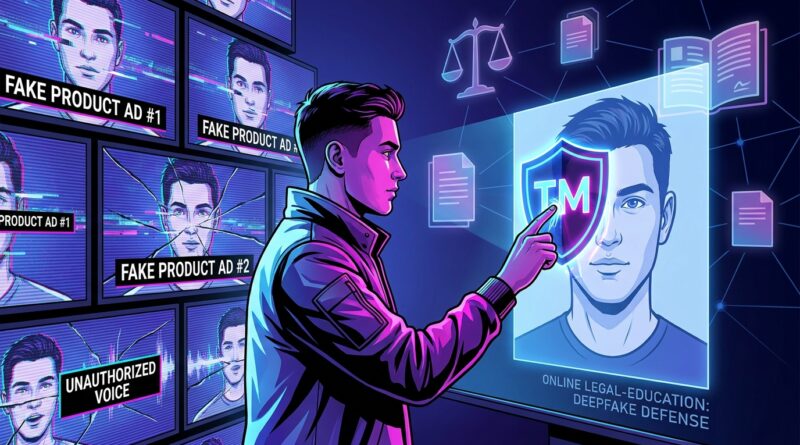
New Deepfake Rules Are Coming For Your Face And Voice: How To Turn Your Personal Brand Into A Trademark Shield
It is a nasty feeling. You open social media and there you are, or at least a pretty convincing fake of you, smiling through an ad for some sketchy supplement, crypto scheme, or get-rich-quick course. For founders, creators, coaches, and solo pros, that is not just embarrassing. It can hurt trust, sales, and your reputation in a single afternoon. The annoying part is that the law still feels patchy. People keep asking the same question: can you trademark your own face, voice, or name and use that as a shield against deepfakes? The short answer is yes, sometimes. But not in the simple “I own my identity” way people hope. Trademark law can protect parts of your identity when they actually function as a brand. That means your name, signature phrase, logo-style signature, and in some cases even a distinctive voice can become useful legal tools right now.
⚡ In a Hurry? Key Takeaways
- You usually cannot trademark your entire identity, but you can protect brand-like parts of it, such as your name, tagline, signature look, and sometimes your voice, if the public connects them to your business.
- Start now by registering the name you sell under, saving proof of use, locking down your social handles, and documenting any fake ads or cloned media the moment you spot them.
- Trademark law helps with confusion in the market, but it is not a magic fix for every deepfake. You may also need publicity rights, platform reports, copyright, and a lawyer’s takedown letter.
The big misunderstanding: you do not trademark “being you”
This is where a lot of people get tripped up. Trademark law is not designed to give you ownership over your whole face, voice, or personality in the abstract.
It protects source identifiers. In plain English, that means things people see or hear and then connect to the source of goods or services. Think business identity, not personal existence.
So if your real name is also the name people know for your podcast, newsletter, consulting firm, course business, or product line, that name may qualify for trademark protection. Same for a catchphrase you always use in commerce. Same for a stylized signature used on products. In some cases, a very distinctive voice can matter too.
What trademark can do against deepfakes
When somebody uses an AI version of you to sell something, the legal issue is often consumer confusion. That is trademark territory.
If viewers are likely to think you endorsed, sponsored, approved, or created that product or content, trademark law may help you argue that the fake is misleading the public and trading on your brand.
Your name can function as a trademark
Your personal name is not automatically protected just because it is your name. It needs to be used as a brand in business.
Examples include:
- Your name on paid courses, books, or consulting packages
- Your name as the title of a creator brand or media channel
- Your name on product packaging, event services, or software
If customers see your name and think, “That comes from that specific person’s business,” you are getting into trademark territory.
Your voice might help, but this is trickier
People are especially nervous about AI voice clones right now, and for good reason. A cloned voice can make fake endorsements sound disturbingly real.
Trademark law may help if your voice is distinctive enough and used in a way that signals source or endorsement. But this area is more limited and fact-specific than people assume. It is not as easy as claiming ownership of your normal speaking voice.
If you want a useful primer on where this is heading, read New Celebrity ‘Voice-Trademark’ Wave: What Small Brands Must Learn From The Taylor Swift Deepfake Fight. The celebrity cases get attention, but the lessons matter just as much for small brands and solo businesses.
Your face alone is usually not a trademark
This is one of the gaps. Your likeness may be very valuable, but trademark law is not usually the cleanest tool for protecting a face by itself.
That is often where rights of publicity, unfair competition claims, false endorsement arguments, and platform policies come into play. Different states also treat image and likeness rights differently, which is part of why this feels messy.
What the new deepfake rules are likely to change, and what they will not
New rules are coming from a mix of state laws, platform policies, and sector-specific guidance. Some focus on election content. Some target non-consensual sexual deepfakes. Some go after deceptive ads or synthetic media without clear disclosure.
That is good news. But it does not mean a perfect rescue is around the corner.
Most founders and creators still need protection they can use now. Trademark is one of the few tools already sitting on the table if your identity is also your brand.
Think of it this way. New deepfake laws may punish or restrict bad behavior. Trademark law helps you prove that the fake is hijacking the trust attached to your business.
When your identity is strong enough to act like a trademark
Ask yourself these simple questions:
- Do customers buy from me under my personal name?
- Do I use a consistent tagline, signoff, slogan, or phrase in paid offerings?
- Do I have a recognizable visual brand tied to my identity?
- Would a customer reasonably assume a fake ad featuring “me” is actually from me?
If the answer to several of those is yes, you may already have the start of trademark protection, even before registration. Registration just makes enforcement easier and stronger.
What to protect first
1. Your business name or creator name
If your name is your business, this is the obvious starting point. Register the mark for the actual goods or services you sell. Be specific. “Online education services,” “marketing consulting,” “downloadable software,” and so on.
2. Your signature tagline
Many creators underestimate this. If you have a repeated phrase that people strongly associate with your business, it may be protectable. This is especially helpful when deepfake content copies your style and signoff to fake authenticity.
3. Stylized signatures, logos, and show titles
These are often easier to register than broad identity claims. If your fake impersonator uses your show name, brand logo, or branded signature graphics, that gives you another clean enforcement hook.
4. Product or service line names
If your personal brand sells under named offers, courses, communities, or products, protect those too. Sometimes the fake content pushes a scam by pretending to be your flagship offer.
What to do this week if you want trademark protection against AI deepfakes of your identity
Audit your brand assets
Make a quick list of every asset the public connects to you:
- Your personal or business name
- Your podcast or channel title
- Your slogan or signoff
- Your logo or stylized signature
- Your product names
Check what is already registered
Before filing anything, search for conflicts. You do not want to build your defense plan around a name somebody else already owns in your category.
Save proof of use
Keep screenshots, product pages, invoices, ad creatives, event pages, social bios, and media mentions showing how you use the name or phrase in business. This matters for both registration and enforcement.
Register the strongest marks first
If budget is tight, do not try to protect everything at once. Start with the mark that does the most business heavy lifting.
Lock down your social handles and domains
This is basic but still missed all the time. A fake campaign gets more believable when it appears under a similar username or website.
Create an evidence folder for impersonation incidents
Save links, timestamps, screenshots, ad libraries, comments, and platform IDs. If the content vanishes, your proof should not.
Where trademark helps, and where it falls short
Trademark is useful because it is practical. But it does have limits.
Trademark is strong when:
- A fake ad suggests you endorsed a product
- Your name or slogan is used to confuse buyers
- Your brand assets are copied in sales content
- The impersonation damages your market reputation
Trademark is weaker when:
- The fake is non-commercial parody or commentary
- Your face appears without clear brand use
- Your name is not actually functioning as a source identifier
- The case is really about privacy, image rights, or defamation instead
That last point matters. A good enforcement plan often uses more than one legal theory at the same time.
Other tools that matter alongside trademark
Right of publicity
This protects against unauthorized commercial use of your name, image, likeness, or persona. Rules vary a lot by state, but this is often a major tool in deepfake cases.
Copyright
If the fake copies your actual videos, audio, scripts, or photos, copyright may be a clean route for takedowns.
False endorsement and unfair competition
These claims can be powerful when the fake makes people think you approved or partnered with a product.
Platform reporting systems
Not glamorous, but often the fastest first move. File reports quickly and attach evidence of your trademark rights, publicity rights, and original content ownership where relevant.
A simple decision test
If someone deepfakes you in a random meme, that is one kind of problem.
If someone deepfakes you to sell something, collect leads, run ads, or fake an endorsement, that is a brand problem. And brand problems are exactly where trademark starts to become useful.
At a Glance: Comparison
| Feature/Aspect | Details | Verdict |
|---|---|---|
| Your personal name | Can be protected if used in commerce as a brand for your goods or services and tied to consumer recognition. | Often the best first trademark filing for founders and creators. |
| Your face or likeness | Usually not a straightforward trademark by itself. Better handled with publicity rights and false endorsement claims in many cases. | Important asset, but not the easiest trademark path. |
| Your voice or catchphrase | A distinctive voice or repeated slogan may help if the public links it to your brand and the fake use causes confusion. | Promising, but more fact-specific and harder than name protection. |
Conclusion
You do not have to sit around waiting for perfect deepfake laws while your reputation is left hanging out in the wind. Over the last 24 hours, online communities have been buzzing about whether you can trademark your own identity, especially as AI deepfakes are used to impersonate real people in ads and social content. The practical answer is that parts of your identity can absolutely become protectable brand assets when they are used that way in the real world. Your name, a signature tagline, a stylized signature, a show title, and sometimes even a distinctive voice can give founders, creators, and solo professionals an immediate path to lock down their digital identity. Trademark will not solve every fake video on its own, and the gaps are real. But it can turn a scary, viral impersonation into a much more manageable legal and business problem. Start with what customers already connect to you. Protect that first. Then if the next fake shows up, you are not just angry. You are prepared.