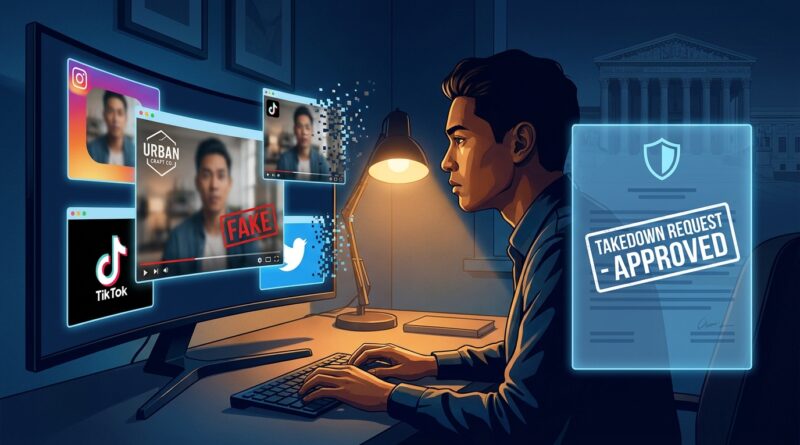
New Deepfake Takedown Deadlines: What Small Brands Must Do Before May 19, 2026
It is maddening to see your face, logo, product photo, or founder video copied, twisted, and reposted like it belongs to someone else. For a lot of small brands, the usual routine has been ugly and slow. You spot a fake, send a complaint, get an auto-reply, then wait while the post keeps spreading. That has left many owners feeling like deepfakes are just part of doing business online now. They are not. A major deadline is coming, and it changes the math.
By May 19, 2026, the TAKE IT DOWN Act’s one-year grace period ends. After that, platforms hosting user content face hard legal duties around certain non-consensual intimate imagery, including AI-generated fakes. For brands, the practical lesson is simple. Get your paperwork, proof, and takedown process ready now. If a fake also uses your name, logo, product shots, or branded content, having basic trademark coverage and a clean notice template can help you move much faster. This is your chance to stop improvising and start responding like a business that knows its rights.
⚡ In a Hurry? Key Takeaways
- The TAKE IT DOWN Act deepfake takedown for brands matters because platforms face tougher legal duties after May 19, 2026.
- Start now by gathering trademark records, image proofs, account links, and a ready-to-send takedown notice template.
- The law helps most with non-consensual imagery, but brands with clear ownership records can also push fake brand content down faster.
Why this deadline matters to small brands
Most small businesses do not have an in-house lawyer, a trust and safety contact at every platform, or time to chase fake content all week. That is exactly why this deadline matters.
Once the grace period ends on May 19, 2026, platforms are under much more pressure to act when they receive valid notices involving covered material. If your founder’s face is placed into a fake clip, if a staff member is targeted, or if fake sexualized imagery is created to embarrass someone tied to your brand, this law gives you a more direct path than “please remove this” emails.
It does not magically erase every fake on the internet. But it does give you a better tool kit, and that alone is a big shift.
What the TAKE IT DOWN Act does, in plain English
The short version is this. The law is aimed at non-consensual intimate imagery, including AI-generated fakes. It creates obligations for covered platforms to remove that content after proper notice.
For a small brand, that can matter in two ways.
1. It protects real people connected to your business
If the target is your founder, creator, employee, or spokesperson, and the fake content falls into the law’s covered category, you may have a stronger takedown route than before.
2. It helps your broader response system
Not every harmful brand fake will fall neatly under this law. A fake product demo, fake endorsement, or fake CEO quote may also involve trademark misuse, copyright issues, impersonation rules, false advertising, or platform policy violations. That means your best move is not to rely on one law alone. It is to build one response packet that lets you point to every valid claim quickly.
What kinds of deepfakes hurt brands the fastest
When people hear “deepfake,” they often think of celebrity face swaps. Small brands have their own version of that problem.
Founder impersonation
A fake video appears to show the owner endorsing a scam, a political message, or a shady investment offer.
Employee targeting
A staff member’s face is used in humiliating or sexualized fake imagery, which can damage morale and the company’s reputation at the same time.
Fake product clips
Your packaging, logo, or product images are dropped into a false testimonial, fake tutorial, or “exposed” style video.
Voice cloning
A copied voice is used in an ad, robocall, or social post that sounds close enough to fool customers.
These situations move fast because the fake content feels personal. People share it before anyone checks whether it is real.
The power shift most founders are missing
Until now, many business owners assumed they had to beg platforms to help. That is the old mindset.
The new mindset is this. You prepare once, then respond fast with proof.
If your notice includes the right links, screenshots, identity details, ownership claims, and legal basis, the conversation changes. Platforms are much more likely to treat you as a serious claimant instead of a random user sending a complaint.
This is also where trademark prep matters. If your logo, brand name, slogans, packaging, or product visuals appear in fake content, clear trademark records can strengthen your position. If you have not looked at that side of the problem yet, read New USPTO Deepfake Policy: How To Trademark Your Real Brand Before AI Clones It. It does a good job connecting AI cloning risks to basic brand protection steps.
Your do-it-today deepfake takedown checklist
1. Make a “brand identity proof” folder
Create one cloud folder with:
- Your legal business name
- Your brand name and any DBAs
- Trademark application or registration records
- Your website and main social links
- Official logo files
- Product photos you own
- Headshots of founders or spokespeople used publicly with permission
This saves time when you need to prove who you are and what belongs to you.
2. Save evidence correctly
When you find a fake, do not just grab one screenshot and hope for the best.
Save:
- The direct URL
- The username or account handle
- Date and time found
- Screenshots of the post and profile
- Screen recordings if the content may disappear
- Any comments showing confusion, scams, or harm
Think like a calm detective, not an angry customer.
3. Separate the legal basis for removal
Ask which of these applies:
- Non-consensual intimate imagery
- Deepfake impersonation
- Trademark misuse
- Copyright infringement
- Fraud or scam content
- Platform impersonation policy violation
One fake post may trigger several of these at once. That is good for you. More valid grounds usually means a better chance of quick removal.
4. Write one strong takedown template now
Do not wait until a fake goes viral. Draft a notice today and save it in a document you can copy and paste.
Your template should include:
- Your full name and role
- Business name
- Links to your official website and official account
- URL of the offending content
- A short description of what is false or unauthorized
- The legal and policy reasons for removal
- A request for urgent review and removal
- Your contact information
5. Assign one person to own the process
If everyone is responsible, nobody is responsible. Pick one person, even if it is the founder, marketing lead, or office manager, to keep the evidence folder and send notices.
A simple notice template you can adapt
Here is a plain-English starting point:
Subject: Urgent takedown request for deepfake and unauthorized brand use
I am contacting you on behalf of [Business Name]. The following content is unauthorized and harmful: [insert URL]. It appears to use the name, likeness, voice, logo, product imagery, or other identifying material associated with our business and/or our personnel without permission.
This content is false, misleading, and damaging. It may also violate your platform’s rules on impersonation, manipulated media, non-consensual imagery, trademark misuse, copyright infringement, fraud, or related policies. Where applicable, this notice is also being submitted under rights and obligations related to the TAKE IT DOWN Act.
Our official website is [URL]. Our official account is [URL]. Attached or linked are screenshots and supporting evidence confirming the unauthorized use.
Please confirm prompt removal of the content and any duplicates, and preserve account records associated with the upload pending further review.
Name
Title
Company
Email
Phone
Is it glamorous? No. Is it useful? Absolutely.
What trademark coverage adds to the fight
Here is the practical truth. The TAKE IT DOWN Act is not a one-size-fits-all brand law. It is focused on a specific kind of harmful imagery. But many fake posts also copy brand assets, and that is where trademarks become useful.
If your logo or brand name shows up in the fake, a platform may take your complaint more seriously when you can point to a registration number, filing record, or at least a consistent history of use in commerce.
That is why basic trademark coverage is not just about paperwork anymore. It is part of your takedown speed.
What to do between now and May 19, 2026
March through summer 2025
Audit your public-facing brand assets. Make a list of your logos, product shots, founder videos, and high-risk content that could be copied.
Fall 2025
Check whether your core brand name and logo are covered. If not, start the trademark process or at least review your options.
Winter 2025 to early 2026
Create your evidence folder, train one staff person, and draft your notice template.
By May 2026
Know where each major platform accepts complaints. Bookmark those forms. Test your internal response process so you are not doing it for the first time in a crisis.
Common mistakes that slow removals
These are the big ones:
- Sending emotional complaints without direct links
- Forgetting to identify the legal basis clearly
- Using old screenshots but no live URL
- Not proving the official account or official website
- Assuming one report is enough when copies are spreading
- Waiting days because nobody internally owns the job
Fast takedowns usually come from boring prep work. That is the part people skip.
At a Glance: Comparison
| Feature/Aspect | Details | Verdict |
|---|---|---|
| TAKE IT DOWN Act coverage | Strongest for non-consensual intimate imagery, including AI-generated fakes, when proper notice is sent to covered platforms. | Very important, but not the only tool a brand should use. |
| Trademark support | Helps when fake posts use your brand name, logo, packaging, or other source identifiers. | Worth setting up now because it can speed up platform responses. |
| Prepared notice template | Lets you send complete, evidence-backed complaints quickly instead of writing from scratch during a panic. | The easiest high-value step for most small brands. |
Conclusion
You do not need to become a deepfake expert before May 19, 2026. You just need a simple system. The TAKE IT DOWN Act’s grace period is ending, and that means platforms that host user content are about to face harder legal obligations around deepfake and non-consensual imagery. For small brands, that flips the power dynamic in a real way. If you prepare now with basic trademark coverage, organized proof of ownership, and a ready-to-send notice template, you can get harmful fakes pulled faster and with less back-and-forth. That is the win here. Not perfect control of the internet, but a practical playbook you can use the same day a fake appears.