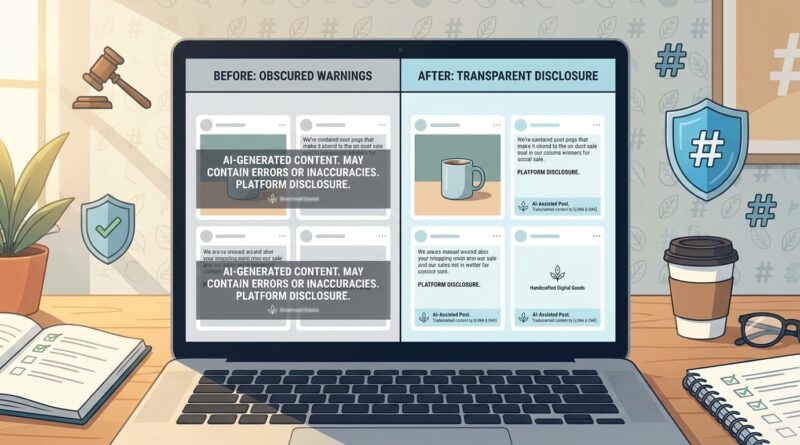
New ‘AI Disclosure’ Rules Quietly Turn Your Brand Voice Into Evidence: How To Tag Your Content So Platforms Don’t Strip Your Trademark Out Of Your Own Posts
You spend years getting your brand to sound like you, then a platform slaps on a plain “AI-generated” label that makes your post look like it came from a content mill. That is the part nobody talks about. The disclosure itself may be required, but the way it appears can quietly bury your name, your slogan, and the little style cues customers recognize. If you are a small founder posting on Instagram, TikTok, LinkedIn, and email, that is frustrating for a simple reason. You are trying to stay compliant without letting your identity get washed out. The good news is you do not have to choose between following the rules and protecting your trademark. You can build a simple tagging system that keeps the required AI notice while still showing clear, repeated proof of who made the content. Think of it as a brand micro-signature. Small. Consistent. Easy to repeat everywhere.
⚡ In a Hurry? Key Takeaways
- Yes, AI disclosure rules can weaken your brand presentation if you let generic labels replace your usual brand identifiers.
- Start using a repeatable micro-signature that pairs the required AI notice with your brand name, slogan, and source line in every post.
- This gives you cleaner trademark evidence, helps prove consistent use in commerce, and makes your content look owned, not anonymous.
Why this is suddenly a real problem
AI disclosure used to sound like a future issue. It is not future anymore. Platforms, marketplaces, and regulators are all moving at once, and they are not waiting for perfect standards.
That creates a mess for small brands. One system adds an “AI-generated” badge. Another inserts a disclosure line. Another strips formatting or crops images so your brand name is no longer the first thing people see.
The legal goal is disclosure. Fair enough. But the branding side effect is that your post can start to look generic, even when the product, offer, and voice are clearly yours.
That matters because trademark protection often depends on consistent, visible use. If your branding becomes faint while the AI label becomes prominent, you are making it harder to show distinctiveness over time.
What “AI disclosure trademark protection for small brands” really means
It sounds technical, but the idea is simple. You want to comply with AI labeling rules without losing proof that the content comes from your business.
For small brands, that means doing three things at once:
- Keeping any required AI disclosure clear and honest.
- Making your brand name and source line just as consistent.
- Saving a record that shows how both appeared together in actual posts.
If you do that well, the disclosure stops being a branding threat and starts becoming part of your evidence trail.
The hidden risk of generic labels
They flatten your voice
If every post gets the same stock notice, your carefully built tone can disappear into a sea of sameness. Your audience remembers phrases, taglines, and visual habits. Generic overlays do not.
They can crowd out your trademark
On some platforms, space is tight. If a disclosure sits above the caption fold, inside the image, or near the username, your own brand markers may become secondary.
They make your content easier to confuse with spam
A lot of low-quality AI content already looks nameless. You do not want your legitimate business to be sorted mentally into that same bucket by customers, reviewers, or marketplace teams.
Use a “micro-signature” instead of a plain disclosure
This is the practical fix. A micro-signature is a short, repeatable line that combines compliance and brand identity.
For example:
- AI-assisted content by BrightThread®. Sew smarter every day.
- Created with AI support by Pine & Loft®. Simple goods for small spaces.
- Brand visuals drafted with AI. Final offer from North Harbor Coffee®.
Notice what these do. They do not hide the AI disclosure. They simply place your brand right next to it in a way that can be repeated across channels.
That repetition is important. Repetition turns a one-off label into evidence of ongoing brand use.
What to include in your micro-signature
1. Your exact brand name
Use the same spelling every time. If you use a registered mark, include the appropriate symbol where it makes sense and where platform formatting allows it.
2. A short brand phrase
This can be your slogan, value statement, or a very short signature line. Keep it brief. You want something you can use everywhere without editing it from scratch.
3. A truthful AI descriptor
Do not overstate or undersell the role of AI. Say “AI-assisted,” “AI-supported,” or “AI-generated draft, reviewed by [Brand Name]” if that is accurate.
4. A source or ownership cue
Examples include “Official post from [Brand],” “Final offer by [Brand],” or “Published by [Brand URL].” This helps when content gets reposted or screenshotted.
How to tag content so platforms do not strip your identity
Put your brand in more than one place
Do not rely on a single logo in the corner. Use layered branding:
- Username or account name
- Caption intro line
- On-image text where appropriate
- Alt text or file naming for your own records
- Footer or signature block in email
If one layer gets removed, another survives.
Keep the wording standardized
Pick one or two approved micro-signatures and use them across your team. Random phrasing creates weak records. Consistent phrasing creates stronger proof.
Make your branded line visible before the cut-off
On social platforms, the first line matters. Try to place your brand name and AI disclosure high enough that they appear before “more” truncates the caption.
Save originals and screenshots
Keep dated copies of the original asset, the posted version, and a screenshot of how the platform displayed it. That gives you a clean record if the visible label later changes.
Platform-by-platform habits that help
Use your brand name in the first caption line. If the image itself contains text, include a small but readable brand identifier that does not get lost when the post is shared to Stories.
TikTok
Since overlays and reposts move fast, include a spoken or on-screen brand cue early in the video. Add the micro-signature to the caption as well.
This is the easiest place to be consistent. Put your disclosure and brand source line in the footer or just above it. Keep the format the same in every campaign that uses AI-assisted content.
Marketplaces and product listings
If product images or descriptions are AI-assisted, keep the seller identity obvious in the listing text and image set. Marketplaces often review context badly when branding is weak.
Turn compliance into trademark evidence
This is where small brands can actually gain something.
If you build a dated archive of posts that consistently show:
- your brand name,
- your slogan or signature phrase,
- your offer or product, and
- your AI disclosure wording,
you are creating a record of real-world use. That can help show your mark is not just an idea sitting on paper. It is in commerce, tied to actual content and actual sales activity.
This same logic shows up in related issues around fake and synthetic media. If that is on your radar, read New EU AI Deepfake Labels Quietly Turn ‘Synthetic Content’ Into Trademark Ammo: How Small Brands Can Turn Fake Videos Into Easy Wins. It is a useful reminder that labels can hurt you, but they can also help you if you structure them properly.
A simple template you can start using today
Short caption template
[Brand Name®] | [Short slogan]. AI-assisted content, reviewed and published by [Brand Name].
Video description template
Official post from [Brand Name®]. Visual draft created with AI support. Final message, offer, and brand presentation approved by [Brand Name].
Email footer template
This email includes AI-assisted creative elements. © [Year] [Brand Name®], [tagline], [website].
These are not magic words. They are just clean, repeatable patterns. That is what matters.
Common mistakes to avoid
Hiding the disclosure
If a rule requires disclosure, do not try to bury it. That creates compliance risk and makes you look slippery.
Using different brand names on different channels
If your Instagram says one thing, your email footer says another, and your TikTok shorthand drops the key wording, your evidence trail gets weaker.
Letting design override legibility
A tiny elegant brand mark that vanishes on mobile is not helping you. Make it readable.
Trusting platforms to preserve context
They often do not. Crops change. badges move. captions truncate. Save your own records.
At a Glance: Comparison
| Feature/Aspect | Details | Verdict |
|---|---|---|
| Generic AI label only | Meets basic disclosure goals but can make your post look anonymous and weaken visible brand identity. | Poor for brand protection |
| AI label plus brand micro-signature | Pairs compliance with consistent brand naming, slogan use, and ownership cues across posts. | Best practical option |
| Saved screenshots and archives | Creates a dated record of how your trademark appeared with the content in the real world. | Very important for evidence |
Conclusion
Small brands should not have to watch years of voice-building get flattened by a one-size-fits-all AI badge. But that is where things are heading if you do nothing. The fix is not complicated. Use the required disclosure, but wrap it in a structured, repeatable micro-signature that clearly shows your name, your wording, and your ownership every time. This helps the community right now because AI-label rules are moving from theory to enforcement in real time, and small brands are the ones most likely to get hit with auto-tagged, boilerplate labels that flatten their identity. Done well, your tags can protect distinctiveness, prove consistent use in commerce, and stop your content from looking like it belongs to a nameless AI farm when regulators or marketplaces take a closer look.