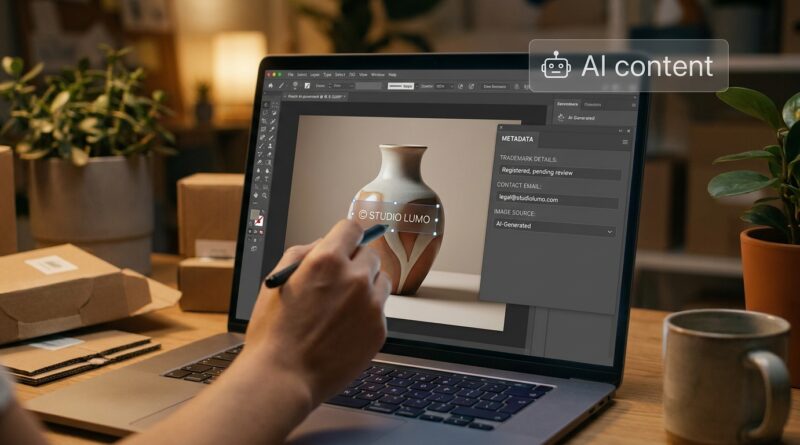
New EU AI Content Labels Quietly Turn Watermarks Into Trademark Shields: How To Stop Platforms Stripping Your Logo Off AI Images
Your AI product image gets reposted. Then cropped. Then screenshot. Your nice little corner watermark is gone, but your logo is still sitting on a fake promo, scam giveaway, or random reseller page. That is maddening, and for small brands it is expensive too. The twist is that new EU AI content labeling rules are pushing platforms to add badges, tags, and metadata for synthetic media. Most people see that as one more compliance headache. Small brands should see something else. A chance to make copied AI images easier to track and easier to challenge when your mark gets misused. This is not about hiding that you used AI. It is about designing AI visuals so your branding survives reposts, keeps context, and gives you better proof when you need to file a takedown. If you start now, the same systems meant to label AI content can quietly help with EU AI content labeling trademark protection.
⚡ In a Hurry? Key Takeaways
- EU AI labels will not protect your brand by themselves, but they can help you prove where an AI image came from and when your mark was stripped or misused.
- Stop relying on one tiny watermark. Put brand cues inside the image itself, in packaging, backgrounds, product labels, and repeated visual details.
- This matters most for small shops because fake ads can spread fast. A stronger evidence trail makes takedowns and trademark complaints much easier.
Why this suddenly matters
A lot of platforms are changing how they treat AI-made images and video. Some are adding visible labels. Some are reading metadata. Some are doing both. The timing is not random. EU rules coming into force around August 2 are putting pressure on large services to identify synthetic content more clearly.
That sounds like a policy story, but it hits real businesses in a very ordinary way. You post an AI-made product mockup on social media. Someone downloads it, crops it, adds a discount sticker, and reposts it. Or they use your logo in a fake testimonial ad. The original watermark disappears in seconds.
The good news is that labels and metadata create a paper trail of sorts. Not perfect. Not magical. But useful. If your original file carries signals that it was your branded synthetic image first, you are in a better spot when you need to show a platform, marketplace, or lawyer what happened.
What the new AI labels actually do, in plain English
Think of these systems as a mix of two things.
1. Visible labels
These are the badges users may see, such as “AI-generated” or “synthetic content.” They warn people that an image or video was made or changed with AI.
2. Hidden metadata
This is information attached to a file, such as the source tool, edit history, or content credentials. Users usually do not see it, but platforms and investigators might.
Here is the catch. Both can be lost when people screenshot, crop, or save a file in a stripped-down format. That is exactly why your brand should not depend on metadata alone, or on one floating watermark in the corner.
The simple shift. Turn your watermark into a system
Most small brands treat watermarking like an afterthought. Add logo. Drop opacity. Put it bottom right. Done.
That worked better when reposting was clumsy and AI fakery was rarer. It is weak now. You need layers.
Use three kinds of brand signals
First, visible branding. This is your normal logo, product name, or URL. Keep it readable, but stop placing all your trust in one easy-to-crop spot.
Second, embedded branding. Put your mark into the scene itself. On a product label. On a box. On a hang tag. On a shop sign in the background. On a repeating pattern. These survive cropping much better.
Third, signature style cues. Use a consistent color combo, prop setup, background texture, framing style, or packaging layout that people connect with your brand. This helps when someone removes the obvious logo but the image still clearly points back to you.
How to stop platforms stripping your logo off AI images
You cannot fully stop other people from downloading and editing your images. But you can make stripping your identity a lot harder and a lot more obvious.
Put the logo where removal damages the image
If the logo sits in empty corner space, it is easy to crop. If it appears on the bottle label, on a product insert, or on a branded sticker sealing the package, removing it means changing the image itself. That leaves more evidence of tampering.
Repeat small brand elements in more than one place
One big mark gets targeted. Three smaller marks, spread naturally through the scene, are harder to erase cleanly. Think product label, box side, and backdrop pattern.
Use branded text that belongs in the photo
Examples include a slogan on the package, a QR-style design element, a branded price tag, or your shop URL on a mailer card. If someone strips all of that out, the edit starts to look suspicious.
Keep the original export with metadata intact
Post compressed versions online if you want, but store your full original file safely. Include date, source prompt if relevant, tool used, and where it was first published. If there is a dispute, your original file is often more useful than the post itself.
Publish first on channels you control
Upload to your own site, store listing, or official social account before seeding images elsewhere. That time stamp matters. It helps show the order of events when copied versions appear later.
What to add to every AI image from now on
If you use AI for social posts, ads, or product shots, make this your new checklist.
- Brand name visible in at least two places
- Logo built into the product or packaging, not just floating on top
- Consistent brand colors and scene style
- Original high-resolution file saved in a secure folder
- Basic record of prompt, tool, date, and first publication link
- Optional hidden file naming convention tied to campaign and date
That may sound fussy, but it is far easier than dealing with a fake ad after it spreads.
Why this helps with trademark complaints
Trademark fights often come down to context. Is that your mark? Was it used in a way that confuses buyers? Can you show the original use and the altered misuse?
EU AI content labeling trademark protection is useful because the new labeling climate makes platforms more aware that synthetic media needs different handling. If your evidence bundle shows an original branded AI image, a later stripped or misleading repost, and a clear time line, you have a cleaner complaint.
You are no longer just saying, “Someone stole my picture.” You are saying, “Here is our original branded synthetic image, here is the altered copy using our mark out of context, and here is why it is likely to confuse customers.”
That is a stronger story for moderation teams, marketplace investigators, and legal counsel.
Do not rely on metadata alone
This part is important. Metadata is helpful, but brittle.
Some platforms preserve it. Some strip it. Some users never see it. Screenshots kill a lot of it instantly. So yes, use metadata and content credentials when available. But always assume the file may get flattened into a dumb image with no hidden history attached.
That is why visible, built-in brand cues matter more than ever.
When fake videos enter the mix
The same problem is showing up in video too. A fake clip can lift your logo, packaging, or founder image and spread much faster than a still photo. If that is on your radar, it is worth reading New EU AI Deepfake Labels Quietly Turn ‘Synthetic Content’ Into Trademark Ammo: How Small Brands Can Turn Fake Videos Into Easy Wins. The core idea is similar. New synthetic-content labels are not just warnings. They can become evidence when someone fakes your brand.
A practical workflow for small brands
Before posting
Create your AI image with brand cues inside the scene. Export the original. Save it with the date and campaign name. Keep a note of the tool used.
When posting
Post first from your official account or website. Add a caption that clearly ties the visual to your brand or campaign. If the platform supports alt text, use it well.
If someone copies it
Grab screenshots of the copied post. Save the URL. Compare it with your original. Circle what was removed, cropped, or altered. Then file a trademark or impersonation complaint, not just a generic copyright complaint if the issue is consumer confusion around your logo or product identity.
If it turns into a scam ad
Move fast. Report it to the platform, ad network, and any marketplace involved. Post a brief warning on your official channel so customers know what is real. Speed matters because scam ads often get mirrored across accounts.
Common mistakes to avoid
Using one giant translucent watermark
It looks protective, but it often makes the image ugly and still gets edited out.
Putting all branding in the bottom corner
That is the first place croppers attack.
Skipping originals
If all you have is the Instagram version, your proof is weaker.
Using AI visuals with no brand identity at all
Pretty generic images are easy for anyone to repurpose. If it could belong to any seller, it probably will.
At a Glance: Comparison
| Feature/Aspect | Details | Verdict |
|---|---|---|
| Corner watermark | Easy to add, easy to crop or blur out, often lost in reposts and screenshots | Better than nothing, but weak on its own |
| Brand built into the image | Logo on packaging, labels, props, repeated scene details, branded background elements | Best practical defense for reposted AI images |
| AI labels and metadata | Useful for proof and platform review, but can disappear after screenshots or file conversion | Strong support layer, not a substitute for visible branding |
Conclusion
Small brands do not need a fancy legal department to get smarter here. You just need to stop thinking of AI labels as someone else’s compliance problem. These new rules are pushing major platforms to treat synthetic media differently, and that opens a door for better EU AI content labeling trademark protection if you prepare your visuals the right way. Build your branding into the image, keep your originals, and create a clear trail from first post to any copied version. That makes it easier to spot misuse, prove ownership, and get bad posts taken down before they spread. If you do this now, you are much less likely to learn the lesson after a fake ad with your logo has already done the damage.