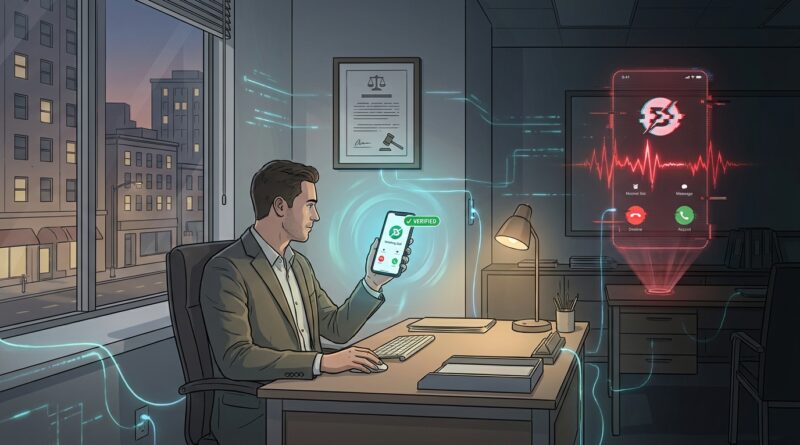
New ‘Voice Impersonation’ Bills Quietly Turn AI Phone Scams Into Trademark Emergencies: How To Lock Your Brand Name To Your Caller ID
Your customers are tired of guessing whether a phone call is real. That is the problem. A fake “billing” or “support” call that uses your business name and a cloned voice can make even loyal customers hang up, panic, or pay the wrong person. Worse, they often blame you first. That is what makes the new wave of state AI voice impersonation bills so important for small brands. These laws do not replace trademark or fraud rules. They add another pressure point you can use when someone copies your voice, your business name, or both. The practical fix is not fancy. Pick one main phone number. Pair it with one consistent caller display name tied to your core brand name. Keep records that prove that setup is yours. Then, if a scam call appears, you have a clean evidence package to send to carriers, call platforms, marketplaces, and payment providers. That can speed up takedowns and reduce damage fast.
⚡ In a Hurry? Key Takeaways
- Your best first move for AI voice impersonation trademark protection is to lock one core brand name to one public-facing business number and use it everywhere.
- Build a simple proof file this week with trademark details, phone records, caller ID screenshots, scripts, and examples of how customers normally hear from you.
- If a scam starts, fast, organized evidence helps carriers, platforms, and payment providers act quicker than a vague complaint ever will.
Why AI phone scams now hit your trademark, not just your customer service
For years, scam calls mostly lived in the fraud bucket. Someone spoofed a number, pretended to be support, and tried to steal money or account access. Now AI voice cloning changes the feel of the scam. It can sound personal. It can sound calm. It can sound like your founder, your office manager, or your support lead.
That matters because the scammer is not just tricking people with a random lie. They are often trading on your brand name. They are using your business identity to gain trust. That pulls trademark issues into the picture alongside fraud and consumer protection.
Several states are moving on AI voice impersonation rules because lawmakers can see the gap. People already know caller ID can be faked. What they do not expect is a cloned voice that sounds enough like a real employee to make the fake call feel legitimate.
What these new state bills actually mean for a small business
Do not overcomplicate this. The new laws are useful, but they are not magic. They do not automatically stop spoofed calls. What they do is give you one more legal and practical angle when you report abuse.
They sit on top of existing rights
If someone uses your business name in a fake call, you may already have claims tied to trademark misuse, unfair competition, fraud, impersonation, and deceptive trade practices. AI voice bills can strengthen your argument because they speak more directly to synthetic or cloned voice abuse.
They can help you tell a cleaner story
Platforms and carriers respond better when your complaint is specific. Instead of saying, “Someone is scamming our customers,” you can say, “A third party used our registered brand name, spoofed our known support number pattern, and used a synthetic voice to impersonate our staff in a way that confuses consumers.” That is sharper. It is easier to route internally. It sounds more urgent because it is.
They do not help much if your own phone identity is messy
This is where many small brands fall down. They use one number on Google, another on invoices, a third in email signatures, and a personal mobile for sales. Then the caller ID name varies too. That makes it harder to prove which number and display name really belong to the brand.
Your first job is simple. Choose your “official” calling identity
If you want real AI voice impersonation trademark protection, start with one clean calling setup that you can defend.
Pick one main public number
This should be the number customers already see, or the number you want them to trust going forward. It should appear on your website, invoices, help center, Google Business Profile, email footer, and customer messages.
If you must keep multiple departments, fine. But one number should be the anchor. Think of it as your front door.
Match the caller display name to your core mark
Use the exact brand name you most want customers to recognize. If your trademark is “Bright Harbor,” do not let half your tools show “BH Support,” “BrightHarbor Help,” and “Harbor Billing Team.” Consistency matters.
Your display name should be short, clear, and as close as possible to your main trademark or trade name. The more variations you create, the easier it is for scammers to hide inside the confusion.
Document why you chose that name
Add one note to your brand assets log that says:
- official customer-facing business number
- official caller ID display name
- date adopted
- systems where it appears
- team owner responsible for updates
That tiny bit of admin work becomes useful later when you need to show that a scammer copied a known brand identifier.
What to put in your brand assets log
Many founders hear “brand assets log” and imagine a legal department. You do not need that. A spreadsheet is enough.
Your must-have columns
- Core trademark or brand name
- Registration number, if you have one
- First date used in commerce, if known
- Main website domain
- Official support number
- Official sales number
- Approved caller display name
- Approved voicemail greeting text
- Known vendor or carrier managing the number
- Links to screenshots showing public use
Also keep proof of normal customer contact
Save screenshots of your website contact page. Save a sample invoice. Save a help center article that tells customers what number you call from. Save a recording of your real greeting if your system allows it.
This does two things. First, it helps customers verify real contact. Second, it helps you prove confusion when a scammer imitates the same setup.
How to build a fast evidence package when a fake call appears
When customers report scam calls, do not scatter the proof across email threads. Build one folder per incident or campaign.
Ask for these five things right away
- Screenshot of the incoming call number and caller ID name
- Date, time, and time zone of the call
- Short summary of what the caller claimed
- Any recording or voicemail left behind
- Whether the caller asked for payment, login codes, or account details
Add your own brand proof
Then pair customer reports with your own records:
- trademark registration or common-law use proof
- screenshot of the real phone number on your site
- caller ID registration records if available
- sample of your real script or greeting
- brief statement explaining customer confusion risk
Now you have something more useful than a complaint. You have a file that shows a third party appears to be trading on your mark and misleading customers.
Who to send that package to
This is where organized brands move faster than everyone else.
1. Your phone carrier or business calling provider
Ask for their fraud or abuse process. If they support branded caller ID, verified calling, or business identity services, ask what records they need to strengthen your profile.
2. The platform used in the scam path
If the fake caller directs victims to a payment app, marketplace listing, fake support page, or messaging handle, report that too. The call is often only the first step.
3. Payment providers
If customers were asked to send money, include the payment destination in your complaint. Fraud teams at payment services may freeze or review accounts faster when the report is tied to impersonation of a real business.
4. State attorneys general or consumer protection portals
Especially in states pushing AI voice impersonation rules, a well-documented complaint can matter. Even if the state cannot solve your case alone, your report adds weight and creates a record.
Why trademark registration still matters here
If your brand name is registered, your report often lands harder. It gives carriers, platforms, and intermediaries a clear marker of ownership. It also makes your story simpler. “This is our registered mark. This number and caller display are part of how we identify ourselves to customers. The scammer is using them to confuse the public.”
If you have not registered yet, do not panic. Common-law rights and normal business records still help. But registration usually makes the paperwork cleaner and the takedown request easier to understand.
A one-week action plan for a small team
Day 1. Pick the official number
Choose the one number that should represent the company in most customer calls.
Day 2. Standardize the display name
Use your core brand name, not a pile of nicknames.
Day 3. Update public touchpoints
Website, invoices, email signatures, contact page, customer portal, and social bios.
Day 4. Build the brand assets log
Make the spreadsheet. Add screenshots. Store it where more than one person can access it.
Day 5. Write the “how we contact you” notice
Tell customers exactly what number you call from, what you will never ask for, and how to verify a suspicious call.
Day 6. Prepare a scam-report template
Create one email template and one internal form so your team gathers the same facts every time.
Day 7. Test your response
Have one coworker pretend to report a fake call. See if the team can collect evidence and produce a clean report in 15 minutes.
What to tell customers so they trust real calls again
You cannot lecture people into trust. You have to make verification easy.
- Publish your official calling number prominently
- Tell customers the exact brand name that should appear on caller ID, if supported
- State clearly that you will not ask for passwords, one-time codes, or unusual payment methods by phone
- Offer a call-back method from your website
- Train staff to welcome verification, not resist it
A simple line works well: “If you ever doubt a call from us, hang up and call the number listed on our website.”
Do not ignore the cross-over with fake video and audio content
Voice scams are part of a bigger impersonation problem. If someone is willing to clone a voice, they may also fake a founder video, support explainer, or product message. That is why it helps to think of your number, name, logo, packaging, and voice as one connected trust system.
If you want to see how similar rules are starting to help in visual deepfake cases too, this related guide is worth your time: New EU AI Deepfake Labels Quietly Turn ‘Synthetic Content’ Into Trademark Ammo: How Small Brands Can Turn Fake Videos Into Easy Wins.
Common mistakes that make scam shutdowns slower
Using too many numbers
If customers cannot tell which number is yours, neither can a carrier abuse desk.
Letting departments invent their own caller names
“Returns Desk,” “Accounts,” and “Premium Support” may sound harmless internally. Outside the company, they create noise.
Waiting to organize proof until after a crisis
By then, people are stressed, screenshots are missing, and no one knows which vendor controls what.
Reporting fraud without mentioning brand confusion
When your trademark or trade name is part of the scam, say so directly.
At a Glance: Comparison
| Feature/Aspect | Details | Verdict |
|---|---|---|
| Official business number | One main public-facing number used across your site, invoices, support pages, and outbound calls. | Best low-cost step. Start here first. |
| Caller ID display name | Should match or closely mirror your core trademark so customers see one consistent identity. | Very important for trust and evidence. |
| Incident proof package | Screenshots, recordings, timestamps, trademark records, and examples of your real contact methods bundled in one folder. | Makes takedown requests much stronger. |
Conclusion
AI voice scams make phone trust feel broken, but small brands are not powerless here. The states moving on AI voice impersonation rules are giving businesses another useful tool, especially when those scams trade on a real brand name. The smart move is to stop treating phone identity as an afterthought. Pick the number and display name that carry your core mark. Record them in a simple brand assets log. Save proof of how customers normally hear from you. Then, if a scammer shows up with a cloned voice and your name in their mouth, you are ready with facts instead of panic. That makes it easier to push carriers, platforms, and payment providers to act quickly. Best of all, this is not a giant compliance project. It is a short, practical checklist a small team can finish in a week, and it can protect years of customer trust.