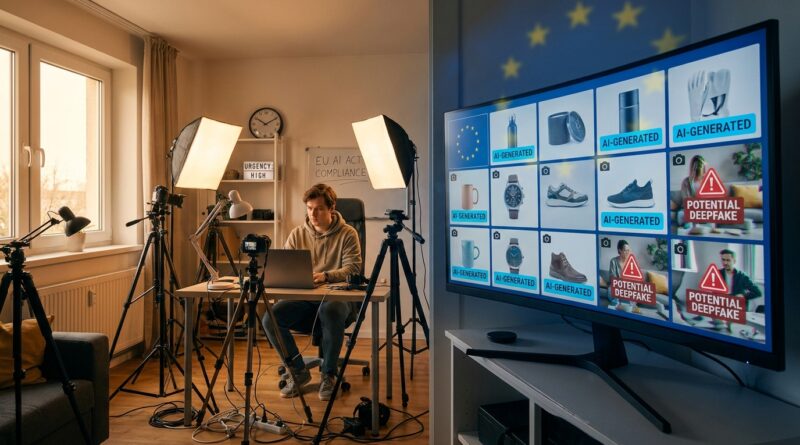
New EU AI Transparency Rules Quietly Turn Your Product Photos Into Evidence Files: How To Label Content So Platforms Stop Guessing For You
If you sell online in Europe, this is the kind of rule change that can sneak up on you and cause a mess later. A product image you cleaned up with generative fill, a lifestyle shot made from a prompt, or a promo reel with an AI voice can now raise labeling questions you probably were not thinking about when you hit publish. That is frustrating, especially for small brands that are already juggling listings, ads, social posts, and trademark protection. The problem is simple. If you do not clearly label what was AI generated, what was AI edited, and what was shot in real life, platforms, marketplaces, and regulators may start making those calls for you. And when that happens, disputes get harder. Takedowns can get weaker. Customers can get confused. Even future arguments about who owns what and what your brand actually looks like can become more complicated than they need to be.
⚡ In a Hurry? Key Takeaways
- If your brand uses AI-made or heavily AI-manipulated images, video, or audio for EU-facing sales, label it now instead of waiting for a platform to flag it.
- Start a simple asset log that records what was photographed, what was AI-assisted, what tool was used, and when each file was published.
- This is not just about compliance. Clear labels and records can help with takedowns, customer trust, and future trademark or ownership disputes.
What changed, in plain English
The EU’s new AI transparency rules are starting to matter in a very practical way. If content is AI generated or made to look convincingly real when it is not, there may be disclosure duties or platform policy issues tied to it. That includes the kind of brand content many small sellers use every day. Product mockups. Lifestyle scenes. Founder videos with AI voice cleanup. Virtual try-on clips. “Behind the scenes” footage that is not really behind the scenes.
The key point is not that all AI use is banned. It is not. The issue is whether your content could be treated as synthetic, manipulated, or misleading without proper context. If that happens, a marketplace may suppress it, label it, remove it, or question it during a complaint process.
Why product photos are suddenly “evidence files”
Once there is a dispute, your product images stop being just marketing. They become evidence. You may need them to prove:
- what your goods actually look like
- how your brand presents itself to customers
- whether a competitor copied you
- whether a takedown request is based on authentic use
- whether a customer was misled by a synthetic demo or scene
If your image was fully generated by AI, or if a real photo was changed enough to alter what is being shown, that can affect how much weight the file carries in a dispute. Think of it like this. A clean studio photo of your real bottle is one thing. A generated “hero image” of that bottle floating in a made-up spa scene, with a cap shape that never existed in production, is another.
What probably counts as AI generated, AI assisted, or manipulated
Likely AI generated
These are the easier ones to spot:
- product or lifestyle images created from a text prompt
- models or influencers who do not exist
- entire promo videos made from AI tools
- synthetic voiceovers that sound human
Likely AI assisted
This is where most small brands live now:
- background extension or replacement
- generative fill to add props or scenery
- AI retouching of lighting, shadows, or reflections
- AI upscaling and cleanup
- AI-written captions paired with real photos
Likely manipulated in a risky way
This is the gray area that causes the most trouble:
- changing the color, shape, finish, or size of the actual product
- showing product results that were not photographed in real life
- making it look like a real person endorsed or demonstrated the product when they did not
- creating fake user-generated content or fake founder clips
A good rule is this. If the edit changes the substance of what a buyer thinks they are seeing, treat it as something that needs a label and a record.
How to label content so platforms stop guessing for you
You do not need a 20-page legal policy to start. You need a working system. Aim for labels that are simple, consistent, and boring. Boring is good here.
Use three internal labels
- Real Capture. Shot in real life. Only normal edits like crop, exposure, dust cleanup.
- AI Assisted. Based on a real photo or video, but AI tools were used for non-trivial edits.
- AI Generated or Synthetic. The visual, audio, or scene was created primarily by AI.
Those labels do not all have to appear publicly in the same way, but they should exist inside your business for every important asset.
Add a short public disclosure where needed
For listings, ads, and social posts aimed at EU users, keep it plain:
- “Product image includes AI-assisted background editing.”
- “Promotional video contains AI-generated scenes.”
- “Voiceover is synthetic.”
- “Concept image. Product shown may include digitally generated elements.”
That kind of wording helps reduce guessing by reviewers and gives you something to point to if a platform challenge comes up later.
The 30-minute asset audit every small brand should do this week
Open a spreadsheet. Seriously. This is one of those unglamorous jobs that saves headaches later.
Track these columns
- file name or URL
- where it is used, marketplace, site, ad platform, social app
- asset type, photo, video, reel, voiceover, graphic
- Real Capture, AI Assisted, or AI Generated
- tools used
- date created
- source files saved, yes or no
- public disclosure added, yes or no
- owner or creator
Start with your top 20 assets. Your best-selling product photos. Your main Amazon or Etsy images. Your Meta ads. Your homepage hero banner. Your TikTok or Instagram reels that are still driving traffic.
Save the proof behind the file
Keep the originals if you can. That means raw photos, earlier versions, prompt logs, editing notes, export dates, and screenshots of platform disclosures. If you ever need to argue that an image reflects a real product, this backup matters.
What this means for trademarks and brand disputes
This is the part many sellers miss. If your core brand visuals are synthetic, or heavily changed from reality, that can muddy future arguments about distinctiveness, use, confusion, and copying. A marketplace or regulator may ask, directly or indirectly, whether the image you are relying on actually shows the product as sold.
That does not mean you cannot use AI in branding. It means you should separate concept art from proof-of-use style assets. Keep authentic product photos for listings, records, and enforcement. Use AI images carefully for campaign art, mood boards, or clearly labeled promotional scenes.
If you ever need to send a takedown notice, the strongest package is usually simple. Here is the real product. Here is the original photo session. Here is the publication history. Here is the listing. Here is the unauthorized copy. Clean evidence wins arguments.
Platform risk is often more immediate than regulator risk
For most small businesses, the first problem will not be a knock on the door from Brussels. It will be a platform moderation bot, an ad review rejection, a marketplace complaint, or a buyer saying “this is not what I received.”
That is why labeling matters now. Platforms are getting more aggressive about synthetic and misleading media. If your internal records are a mess, you are left trying to reconstruct what happened after a listing gets flagged.
A sensible house policy for small teams
If you have one employee, a freelancer, or a small agency helping with content, write a one-page rule set:
- Real product listings must have at least one unaltered real-life image on file.
- Any AI-generated asset must be tagged before upload.
- No fake testimonials, fake unboxings, or fake founder footage.
- No AI edits that change the physical product without approval.
- Disclosures must be added for EU-facing content when AI materially shaped the final output.
This is not overkill. It is basic housekeeping now.
When you should be extra careful
Some content deserves a second look before it goes live:
- before-and-after demos
- beauty, wellness, and supplement ads
- children’s products
- luxury goods and counterfeiting complaints
- founder or influencer endorsements
- anything you may later use in an IP dispute
If the content touches trust, safety, or authenticity, assume the standard will be higher.
At a Glance: Comparison
| Feature/Aspect | Details | Verdict |
|---|---|---|
| Real product photo | Shot in real life, only minor standard edits, backed by source files | Best for listings, disputes, and trademark support |
| AI-assisted image | Real photo with meaningful AI edits such as generated backgrounds or object cleanup | Usually usable, but label it and document changes |
| Fully AI-generated promo asset | Created mainly by prompts, synthetic scenes, people, or audio | Fine for some marketing, but higher risk if passed off as real evidence |
Conclusion
You do not need to panic, but you do need to sort your files out. The smart move is to decide, now, which brand assets are real captures, which are AI-assisted, and which are fully synthetic. Then label them, save your proof, and add plain disclosures where they matter. This helps the community today because the EU’s new AI transparency obligations for AI-generated and deepfake-style content just became enforceable, and they directly affect how your brand assets are labeled, flagged and trusted across platforms. If you do not proactively label and document what was AI-assisted and what was shot in real life, marketplaces and regulators will make those calls for you. And that can weaken takedown claims, confuse customers, and complicate future trademark and ownership disputes. A simple spreadsheet and a few clear labels can save you a lot of trouble later.