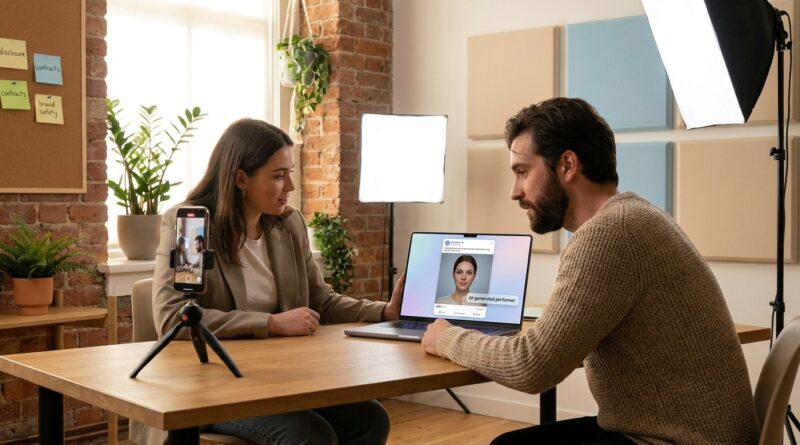
New Synthetic Performer Disclosure Law: How To Protect Your Brand When Ads Must Admit They Used AI
You spend days getting an ad polished. The visuals look great. The voice sounds human. The sponsored post is ready to publish. Then someone on your team says New York now requires disclosure if that “person” in the campaign is synthetic or digitally altered. That is the kind of last-minute headache that makes a simple launch suddenly feel like a legal project.
The good news is this does not automatically mean you need to scrap the campaign. It means you need to get clear, fast, about where AI was used, how obvious that use is, and whether your ad copy, on-screen text, contracts, and influencer instructions need an update. New York’s synthetic performer disclosure law took effect on June 9, 2026. It matters well beyond New York because major state rules often become the practical standard for brands, agencies, and platforms everywhere. If you run digital ads, sponsored content, or social campaigns with AI-generated or digitally altered people, now is the time to clean this up before an audience, a platform, or a regulator does it for you.
⚡ In a Hurry? Key Takeaways
- New York’s synthetic performer disclosure law means many ads and sponsored posts using AI-generated or digitally altered performers now need a clear disclosure.
- Start by reviewing every campaign asset, then add plain-language disclosures, update creator briefs, and put AI-use terms into contracts.
- Even if your business is not based in New York, this is worth treating as a broader compliance standard because platforms and other states often follow.
What changed, in plain English
The New York synthetic performer disclosure law took effect on June 9, 2026. The short version is simple. If your advertising or sponsored content uses a synthetic performer, or a real performer whose appearance, voice, or actions were digitally altered in a meaningful way, you may need to clearly tell people that is what they are seeing.
This hits more than obvious AI avatars. It can also reach cloned voices, digitally altered spokespeople, fake influencer-style testimonials, and heavily edited “people” in social campaigns. If the audience could reasonably think a real human is endorsing, demonstrating, or appearing in the content, disclosure becomes the safe starting point.
That matters because lots of small brands have quietly started using AI for ads. Not to trick people, usually. Just to save time and money. A synthetic model is cheaper than a photo shoot. A cloned voice is faster than booking talent. A digital influencer can post around the clock. But once the law says you cannot hide the synthetic nature of a performer, “everyone does it” stops being much of a defense.
Why small brands and creators should care right now
You do not need a Madison Avenue budget to get caught by this. In fact, smaller teams are often at more risk because they move fast and do not have legal review built into every campaign.
It is not just a New York problem
If your ads are visible in New York, sold into New York, or distributed on platforms that want one consistent rule for everyone, this can affect you. A business in Texas, Ohio, or California can still end up changing creative because a platform, agency partner, or ad network decides New York’s rule is now the baseline.
Audience trust is part of the issue
Even when a regulator never calls, customers can. People get touchy when they feel fooled, especially with fake endorsements or influencer content that looks personal but is partly machine-made. One screenshot on social media can turn “clever creative” into “why were they hiding this?” very quickly.
Platforms may become stricter than the law
That is how this usually goes. A law lands. Then platform policy teams, ad review bots, and agency compliance checklists start adding their own versions. So if you are only asking, “What is the minimum legal requirement?” you may still be behind.
What counts as a synthetic performer?
Think broadly. A synthetic performer is not only a fully fake AI person.
It can include:
- An entirely AI-generated person in a video or image ad
- A cloned or synthesized voice that sounds like a human spokesperson
- A digital avatar used in sponsored content or endorsements
- A real performer whose face, mouth movement, body, or speech was significantly altered by software
- An influencer-style character presented as if they are a real person giving a genuine opinion
When in doubt, ask a simple question. Would an ordinary viewer think this is a real person, speaking or appearing naturally, if you did not tell them otherwise? If the answer is yes, disclosure is probably the safer move.
What kind of campaigns are most likely affected?
The law matters most for commercial content. That includes:
- Paid social ads
- Display and video advertising
- Sponsored influencer posts
- Brand partnership videos
- Product endorsements
- Landing pages tied to ad campaigns
- Short-form videos used to sell or promote products and services
If your content is trying to persuade someone to buy, sign up, trust, click, or join, treat it as a campaign that deserves a compliance check.
What you should do this week
1. Audit your live and scheduled campaigns
Make a list of every active or upcoming ad, sponsored post, and branded video. Then mark which ones include:
- AI-generated people
- AI voiceovers that sound human
- Face swaps or digital body changes
- Edited spokesperson footage
- Influencer content created with significant synthetic elements
If you cannot tell how an asset was made, ask the agency, freelancer, production shop, or creator who made it. Do not guess.
2. Add clear disclosure language
This is not the moment for cute wording. Be direct. People should not need a magnifying glass or a law degree to understand it.
Examples:
- “This ad includes an AI-generated performer.”
- “Synthetic voice used in this promotion.”
- “This sponsored content uses a digitally created person.”
- “Performer appearance and voice were digitally altered.”
Put disclosures where people will actually see them. On-screen in video. In captions for social posts. Near endorsement copy on landing pages. Tiny footer text that disappears in two seconds is asking for trouble.
3. Update influencer and creator briefs
If you work with creators, stop assuming they know the rule. Put it in writing. Tell them when AI use must be disclosed, what wording is approved, and where it needs to appear.
A lot of brands are careful on their own channels but loose on creator campaigns. That is a weak spot. If a sponsored creator uses a synthetic co-host, cloned voice, or digitally altered self-presentation without proper disclosure, your brand may still be the one in the screenshot.
4. Tighten your contracts
Your agreements with agencies, freelancers, production vendors, and influencers should now cover:
- Whether AI or digital alteration was used
- Who is responsible for disclosure language
- Who gives final approval
- Whether the vendor promises compliance with New York and platform rules
- What happens if an asset needs to be pulled or redone
This is one of those boring edits that saves real money later.
5. Keep proof of your process
Save drafts, approvals, creator instructions, and production notes showing how you identified synthetic content and added disclosure. If someone challenges the campaign later, having a paper trail helps show you tried to do this correctly.
How obvious does the disclosure need to be?
As a rule, obvious beats clever. If the ad has a synthetic performer, the disclosure should be easy to notice and easy to understand.
Good disclosure usually means:
- Plain words
- Readable size
- Enough time on screen to be read
- Placement near the performer or endorsement
- No hiding in a wall of hashtags or legal copy
If your team is debating whether the average viewer would miss it, they probably would.
Common mistakes brands are about to make
Thinking “digitally altered” only means deepfakes
It is broader than that. If software significantly changes a performer’s voice, face, movement, or presentation in a way that affects how viewers understand the endorsement, you should at least review it closely.
Forgetting old assets still matter
Do not only check new campaigns. Review evergreen ads, always-on paid social, and old product videos still running in rotation.
Relying on the creator to handle it
Some creators are careful. Some are not. If your brand is paying for the message, your team should review the final disclosure too.
Assuming “people won’t care”
People care a lot more when money and trust are involved. A synthetic lifestyle influencer posting a sponsored recommendation without clear disclosure can feel deceptive fast.
A simple compliance checklist for non-lawyers
Use this before anything goes live:
- Does this ad or sponsored post show or use a person, voice, or persona?
- Was that person fully AI-generated, partially synthetic, or heavily digitally altered?
- Would a normal viewer assume the performer is real and unaltered?
- Is there a clear disclosure in the ad, caption, or post?
- Has the creator, agency, or editor confirmed how the asset was made?
- Does the contract assign responsibility for disclosure and compliance?
- Have we saved the final approved version and instructions?
If you answer “I’m not sure” to any of those, pause the launch and sort it out first.
What to tell your team without causing a panic
You do not need to ban AI. You need rules for using it.
Try something like this internally: “We can still use AI-generated or digitally altered performers in ads, but if the content could make people think a real human is appearing or endorsing naturally, we need a clear disclosure and documented review.”
That is a lot easier for a marketing team to follow than a vague warning to “be careful with AI.”
When it is smart to get legal review
Not every Instagram post needs outside counsel. Some do.
Get legal eyes on it if:
- The ad features a realistic synthetic spokesperson
- You are cloning a voice or likeness
- The endorsement could affect health, finance, or other sensitive buying decisions
- You are running a large multi-state campaign
- Your agency cannot clearly explain how the performer was created or altered
Think of legal review as a pressure valve. It is cheaper than pulling a campaign after launch.
At a Glance: Comparison
| Feature/Aspect | Details | Verdict |
|---|---|---|
| AI-generated performer in a paid ad | A fully synthetic person appears to promote a product or service | Add a clear disclosure before publishing |
| Digitally altered real spokesperson | A human performer’s voice, face, or actions are significantly changed with software | Review carefully and disclose if viewers could be misled |
| Influencer-sponsored social content | A creator uses synthetic elements in a branded post, reel, or story | Update briefs, captions, and contracts now |
Conclusion
New York’s synthetic performer disclosure law is the kind of rule that sounds narrow until you look at your own ad stack and realize how much modern marketing now mixes real people, edited people, and fully synthetic ones. Since it took effect on June 9, 2026 and applies directly to digital ads, sponsored content, and social campaigns using AI-generated or digitally altered performers, it deserves immediate attention. That is especially true for small brands, influencers, and creative shops, because once a major state sets the tone on AI disclosure, platforms, agencies, and regulators often start treating it like the new normal. The practical move is not panic. It is cleanup. Audit your campaigns, add plain disclosures, update contracts, and give creators clearer instructions. Do that now, and you have a much better shot at avoiding the attorney general letter, the platform rejection, or the angry customer screenshot that turns a clever campaign into a trust problem.